If you’re a buyer working with stainless steel flat-top chains—whether for food processing, material handling, heavy-duty manufacturing, or industrial automation—you already know how much hinges (pun absolutely intended) on their quality. As someone who’s been supplying these chains for over 12 years, I’ve seen firsthand that a chain that looks shiny in a catalog can turn into a costly headache: unplanned downtime, premature wear, even product contamination in food or pharmaceutical lines. I’ve also fielded my fair share of calls from frustrated clients who bought cheap, off-spec chains that failed within weeks. That’s why I want to break down the actionable, science-backed checks I teach every new member of my team—and why they’re non-negotiable before you pull the trigger on a bulk order. Stainless Steel Flat-top Chains

Let’s start with the basics: stainless steel flat-top chains aren’t just polished metal links. Their design is intentional: flat, interlocking plates (the “flat-top” part) create a smooth surface for conveying, while the side plates, pins, and rollers work together to bear load and move with precision. Quality here isn’t about brand name; it’s about material consistency, dimensional accuracy, and manufacturing precision that meets or exceeds industry standards. Skimp on any of these, and you’re looking at chain failure that costs you more than the savings on a cheaper batch.
First up, material grade verification—and this is where so many buyers get burned. Not all stainless steel is the same. For flat-top chains, the two most common grades are 304 (18/8 food-grade) and 316 (marine-grade, with 2-3% molybdenum for corrosion resistance). But here’s the thing: a lot of cut-rate suppliers will label their chains “stainless steel” but use 200-series stainless, a lower-grade alloy that’s cheaper but prone to rust, especially in wet, high-humidity, or chemical environments. So how do you check this, without sending a sample to a lab right away?
The first quick test is the magnet test. Wait, I know—there’s a myth that all stainless steel is non-magnetic. It’s true that austenitic grades like 304 and 316 are low-magnetic, but they’re not completely non-magnetic (that’s a common misperception). Ferritic or martensitic grades, which are magnetic, are even worse for flat-top chains because they corrode faster. The key here is that a strong, consistent magnetic pull means you’re not looking at a proper 304 or 316 grade. Test a few random links from the batch—if every single one sticks firmly to a magnet, run for the hills. That said, some 304 grades can have slight magnetic pull from manufacturing processing (cold working during stamping), so it’s not a hard pass on minor pull, but a strong, uniform magnet attraction is a red flag.
For a more accurate check, especially if you’re working in a corrosive environment, use a stainless steel test kit (they’re cheap, available online, and every supplier should have them on hand for pre-shipment checks). The chromium test reagent will turn a distinct color if the chain has the minimum 10.5% chromium required for true stainless steel—look for a light green or blue color, not a faint yellow, which indicates low chromium content. For 316-grade chains, add a molybdenum test strip; it should register a positive result, as molybdenum is what makes 316 resistant to salt, acids, and harsh cleaning chemicals. I test every batch we ship before it leaves our warehouse—no exceptions.
Next, dimensional accuracy. This is make-or-break for flat-top chains, because even a 0.1mm difference in plate thickness or pin diameter can cause misalignment in your conveyor system, leading to jams, uneven load distribution, and accelerated wear. Let’s get specific: for most standard flat-top chains, side plate thickness should be consistent within ±0.05mm, pin diameter within ±0.03mm, and the pitch (distance between each pin) should be held to ±0.1mm per link, with no cumulative pitch error over a 10-link span. Why? Because cumulative pitch error over 20 links, for example, can throw the whole conveyor track off, causing the chain to skip or even break.
How do you check this? Don’t just measure one link—pick 5 random links from different parts of the pallet (not just the top layer, where suppliers often hide bad batches) and measure each critical dimension with a digital caliper (a manual caliper won’t give you the precision you need). Then, measure the pitch across 10 consecutive links: add 10 individual pitches and divide by 10 to get the average, and check that it’s within the manufacturer’s specified tolerance. I’ve had clients come to me with chains that were marked as T2050 flat-top, but their pitch was off by 0.5mm—enough to render the chain incompatible with their existing sprockets. That’s a $10,000 mistake before they even run the chain.
Then there’s surface quality and finish. You might think a shiny, smooth surface is just cosmetic, but it’s functional too. For food-grade flat-top chains, a smooth, non-porous finish is critical to prevent bacteria, food particles, or cleaning chemicals from getting trapped in crevices, which can contaminate product or speed up corrosion. For industrial applications, a rough surface on side plates or pins will create friction, leading to faster wear on the chain and the conveyor sprockets.
Run your finger gently along the side plates and pin holes—if you feel any burrs, sharp edges, or uneven spots, that’s a sign of sloppy manufacturing. Burrs on pins can wear down roller surfaces over time, and rough side plates will catch on conveyor guides, causing jams. Also, check for discoloration: any dark spots, smudges, or uneven tarnish is a sign of improper heat treatment during manufacturing, which weakens the steel and makes it prone to rust. We use a vibratory deburring process for all our chains to eliminate burrs, and every batch goes through a visual inspection under bright light—no discolorations leave our facility.
Load capacity testing is another step I recommend, especially for heavy-duty applications like automotive assembly lines or bulk material handling. Most suppliers will state a “working load limit” for their flat-top chains, but that number is only accurate if the chain was properly heat-treated and constructed with quality materials. To test this, you can do a simple static load test in your own facility: attach a section of chain to a rigid frame, apply a load of 1.5x the stated working load limit for 24 hours, then inspect for stretching, deformation, or crack formation. If the chain stretches more than 0.2% (which is standard for acceptable plastic deformation), or if you see any cracks in the side plates, it’s not up to par. I always recommend this for bulk orders over 500 feet—we offer free sample testing for qualifying clients, because we’re confident our chains pass every load test we can throw at them.
Corrosion resistance testing is critical if your chain will be used in wet, outdoor, or chemical environments. Even 316-grade stainless steel can corrode if it’s not properly finished or if it’s exposed to harsh substances like hydrochloric acid or high-salt brine. A quick at-home test is the salt spray test: submerge a 6-inch section of chain in a 5% saltwater solution for 48 hours, then inspect for rust. If you see any red rust spots, the chain’s surface has not been passivated properly (a process that seals the chromium layer on stainless steel to prevent corrosion), which is a manufacturing defect. For more rigorous testing, you can use a salt spray chamber, but the simple at-home test is a great starting point.
Another often-overlooked check is the pin and roller fit. Flat-top chains rely on tight, consistent fit between pins, rollers, and side plates to distribute load evenly. If the pin is too loose in the side plate hole, the chain will have excessive play, leading to wobbling, increased friction, and premature wear. To check this, pull gently on two adjacent side plates in opposite directions—if you feel more than 0.5mm of play, the pin fit is too loose, which will cause the chain to fail early. We press-fit all our pins to a precise tolerance, so there’s minimal play—less than 0.1mm—ensuring smooth, consistent operation over thousands of operating hours.
I also can’t stress enough the importance of traceability and supplier documentation. A reputable stainless steel flat-top chain supplier will provide a material test certificate (MTC) for every batch, which confirms the material grade, chemical composition, and mechanical properties of the chain. If a supplier hesitates to provide an MTC, that’s a major red flag—they’re probably cutting corners on material or manufacturing. For food-grade applications, you also want to make sure the chain meets FDA 21 CFR standards, and for pharmaceutical or high-purity applications, check for compliance with ISO 9001 or GMP guidelines. I keep a digital copy of every batch’s MTC, and I’m happy to share it with clients at any time—transparency is non-negotiable for us.
Let me share a quick story to illustrate why these checks matter. A food processing client reached out to me last year after buying a 1,000-foot batch of flat-top chains from a new supplier. Within two months, the chains were showing rust spots, and small metal shavings were getting into their frozen vegetable product, leading to a $50,000 recall and downtime. When we tested the chains, we found they were made from 201-grade stainless steel, not 304 as labeled—their chromium content was only 12%, well below the 10.5% minimum for stainless steel, and no MTC was provided. We ended up replacing their entire chain at no cost, because we know how damaging bad products can be. That’s why we built our business around quality, not cut-rate pricing.
So, to wrap this up, checking the quality of stainless steel flat-top chains isn’t rocket science, but it does require attention to detail and a willingness to ask the right questions. Start with material grade verification (magnet test, test kits), move to dimensional accuracy (digital calipers, pitch checks), inspect surface quality for burrs and discoloration, test load capacity and corrosion resistance, and always demand documentation.
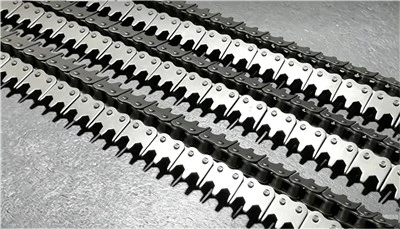
If you’re in the market for reliable, high-quality stainless steel flat-top chains, I’m here to help. We specialize in custom and standard flat-top chains for every application, from food processing to heavy manufacturing, and every batch is tested and inspected before it leaves our facility. Reach out to discuss your specific needs, request a free sample, or get a detailed quote—we’ll work with you to find the right chain for your operation, no hidden fees, no subpar products.
Leaf Chain References
ASM International. (2020). Stainless Steel: Properties and Applications. ASM Handbook Volume 1: Properties and Selection: Irons, Steels, and High-Performance Alloys.
ISO 9001:2015. Quality management systems — Requirements. International Organization for Standardization.
U.S. Food and Drug Administration. (2023). Food Contact Materials: Stainless Steel. 21 CFR Part 175, 176, 177, 178.
Anhui Huihuang Chain Transmission Co., Ltd.
Anhui Huihuang Chain Transmission Co., Ltd. is one of the most professional stainless steel flat-top chains manufacturers and suppliers in China, also supports high quality customized service. Please feel free to buy discount stainless steel flat-top chains made in China here from our factory. Welcome to contact us for pricelist and free sample.
Address: NO.3 YONGQIANG ROAD. JIXI.ANHUI.CHINA
E-mail: 754590660@qq.com
WebSite: https://www.hhchains.com/
