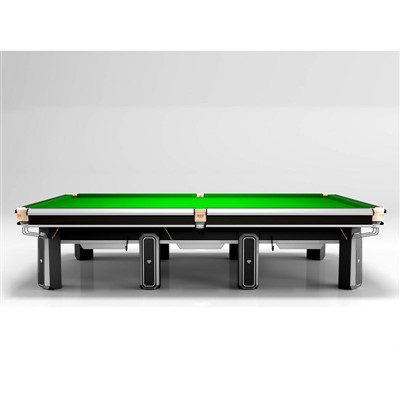
When it comes to snooker, one of the most fascinating aspects is the precision required in calculating angles on the pool table. As a supplier of high – quality snooker pool tables, I’ve witnessed firsthand how understanding these angles can transform a player’s game. In this blog, I’ll delve into the methods and principles behind calculating angles on a snooker pool table. Snooker Pool Table
The Basics of Snooker Angles
At the heart of snooker is the concept of angles. Every shot, whether it’s a simple straight – in shot or a complex bank shot, involves an understanding of how the cue ball will interact with the object ball and the cushions of the table. The angle at which the cue ball strikes the object ball determines the direction in which the object ball will travel.
The first principle to understand is the law of reflection. This law states that when a ball hits a cushion, the angle of incidence (the angle at which the ball approaches the cushion) is equal to the angle of reflection (the angle at which the ball leaves the cushion). For example, if a ball approaches a cushion at a 30 – degree angle, it will bounce off the cushion at a 30 – degree angle in the opposite direction.
Calculating Angles for Straight – In Shots
Straight – in shots are the simplest type of shots in snooker. In a straight – in shot, the cue ball, the object ball, and the pocket are all in a straight line. To calculate the angle for a straight – in shot, you simply need to ensure that the center of the cue ball is aimed directly at the center of the object ball.
However, it’s important to note that even in straight – in shots, there can be factors that affect the angle. For example, the speed of the cue ball and the spin applied to it can cause the ball to deviate from a perfectly straight path. Topspin, for instance, will make the cue ball continue forward after hitting the object ball, while backspin will make it stop or even reverse direction.
Bank Shots and Angle Calculation
Bank shots are more complex than straight – in shots. In a bank shot, the object ball is aimed at a cushion before being directed into a pocket. To calculate the angle for a bank shot, you need to use the law of reflection.
First, you need to identify the point on the cushion where the object ball will hit. Then, you can draw an imaginary line from the object ball to the point of contact on the cushion. Next, draw a perpendicular line to the cushion at the point of contact. The angle between the line from the object ball to the point of contact and the perpendicular line is the angle of incidence.
To determine the angle of reflection, you simply make it equal to the angle of incidence. Once you have the angle of reflection, you can draw a line from the point of contact on the cushion to the pocket. This line represents the path that the object ball should take after hitting the cushion.
Using the Diamond System
The diamond system is a popular method for calculating angles on a snooker pool table. The system is based on the diamonds or markers that are placed along the rails of the table.
To use the diamond system, you first need to identify the diamonds on the rail between the object ball and the pocket. Each diamond represents a specific angle. For example, if you are aiming to bank a ball off the rail, you can use the diamonds to estimate the angle of incidence and reflection.
Let’s say you want to bank an object ball off the long rail into a corner pocket. You can use the diamonds to determine the point on the rail where the ball should hit. By counting the diamonds from the object ball to the point of contact on the rail, you can estimate the angle at which the ball should approach the rail.
Advanced Angle Calculation: Using Geometry
For more advanced players, geometry can be used to calculate angles on a snooker pool table. By using the principles of trigonometry, you can calculate the exact angles for shots.
For example, if you know the distance between the object ball and the cushion, and the distance between the point of contact on the cushion and the pocket, you can use the tangent function to calculate the angle of incidence and reflection.
Let’s assume that the distance between the object ball and the cushion is (x) and the distance between the point of contact on the cushion and the pocket is (y). The tangent of the angle of incidence (\theta) is given by (\tan(\theta)=\frac{y}{x}). You can then use a scientific calculator to find the value of (\theta).
Factors Affecting Angle Calculation
There are several factors that can affect the accuracy of angle calculation on a snooker pool table. The condition of the table is one of the most important factors. A table with a worn – out cloth or uneven surface can cause the balls to deviate from their expected paths.
The type of balls being used also matters. Different balls have different weights and sizes, which can affect their movement on the table. For example, a heavier ball may be more affected by friction than a lighter ball.
The speed and spin of the cue ball are also crucial. As mentioned earlier, topspin and backspin can change the direction of the cue ball after it hits the object ball. Side spin, or English, can also cause the ball to curve, making angle calculation more challenging.
The Importance of Practice
While understanding the principles of angle calculation is important, practice is the key to mastering the art of snooker. By practicing different types of shots and experimenting with different angles, players can develop a better sense of how the balls will behave on the table.
As a supplier of snooker pool tables, I encourage players to spend time on our high – quality tables. Our tables are designed to provide a smooth and consistent playing surface, which is essential for accurate angle calculation. The precision – engineered cushions and high – quality cloth ensure that the balls move predictably, allowing players to focus on honing their skills.
Conclusion

Calculating angles on a snooker pool table is a complex but rewarding skill. By understanding the basic principles of the law of reflection, using methods like the diamond system, and applying advanced geometry, players can improve their accuracy and become more successful in the game.
Billiard Accessories If you’re interested in purchasing a top – quality snooker pool table for your home or business, I invite you to contact us for a detailed discussion. Our team of experts is ready to assist you in finding the perfect table that meets your needs and budget. Whether you’re a professional player or a casual enthusiast, our tables are designed to provide an exceptional playing experience.
References
- "The Official Rules of Snooker" published by the World Snooker Association.
- "Advanced Snooker Techniques" by a well – known snooker coach.
- "Physics of Billiards" from a scientific journal on sports physics.
Shuai Zhanjiang (Dongguan) Co., Ltd.
As one of the leading snooker pool table manufacturers and suppliers in China, we offer a wide range of products with superior quality. Please rest assured to buy snooker pool table made in China here from our factory. We also accept customized orders.
Address: No. 50 Siyuan Road, Changping Town, Dongguan City, Guangdong Province
E-mail: cbibilliard01@gmail.com
WebSite: https://www.cbibilliard.com/
